I reviewed and tested multiple software platforms built for courier companies to compile this list of the best 5. These tools help courier businesses manage dispatch, route optimization, driver tracking, proof of delivery, and customer notifications, all without needing a dedicated engineering team to set things up.
Best Courier Service Software: TL;DR
| Platform | Best for | Delivery model | Free trial | Pricing |
|---|---|---|---|---|
| Onro | Courier companies needing a full operational stack | On-demand, same-day, next-day | Free demo, no credit card | From $239/month (Business plan) |
| Shipsy | Enterprise carriers and 3PLs | All models at enterprise scale | Demo by request only | Custom pricing |
| Tookan | On-demand delivery with an extensible platform | On-demand | 14-day free trial | From $39/month (add-ons cost extra) |
| Routific | Small-to-mid fleets optimizing planned routes | Planned batch delivery | 7-day free trial | Free up to 100 orders; from $150/month |
| GSMtasks | Small teams needing affordable task management | Planned delivery & field service | 14-day free trial | From €14/user/month |
Choosing the best software for your courier company depends on your delivery model, fleet size, operational complexity, and whether you need features like hub operations, COD management, or white-label branding.
Let’s explore each of these platforms in detail.
1. Onro: Best for courier businesses that need the full operational stack
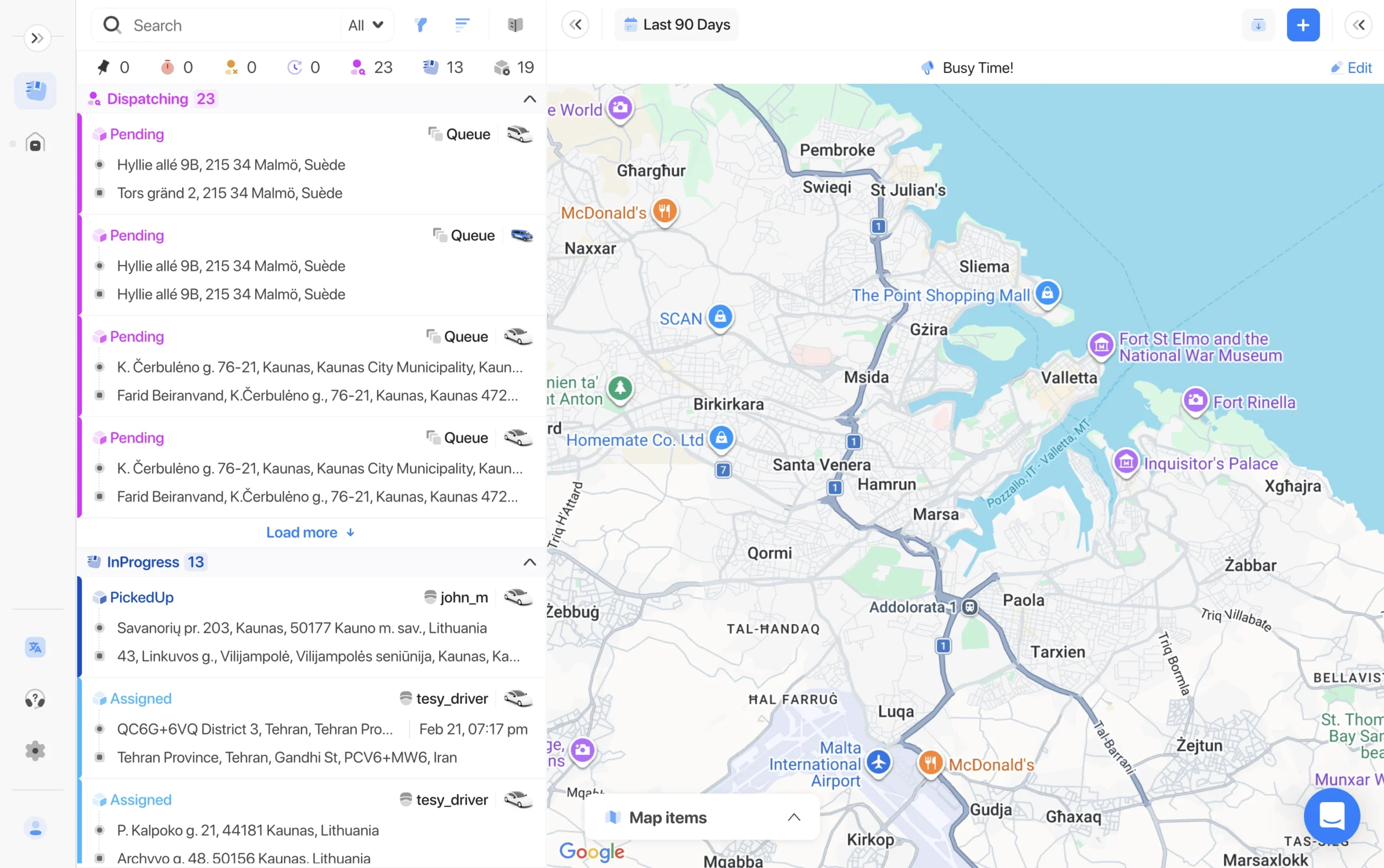
Onro is a purpose-built courier management platform that covers the entire delivery lifecycle in a single product. It’s designed specifically for courier operations, handling on-demand dispatch, hub inbound scanning, COD settlement, multi-merchant billing, and white-labeled customer and driver apps.
What differentiates it from most tools in this price tier is breadth. Many platforms handle either dispatch or route optimization or COD. Onro combines these, plus hub operations, a capability that’s rare in the SMB segment.
Key features
- On-demand auto-dispatch with live order queue and nearest-available driver assignment
- Hub operations with dedicated scanner app: inbound scan, sorting by zone, outbound scan, and mid-mile transfer between hubs
- COD management and driver wallet: full cash collection, tracking, and settlement workflow
- Full white-label stack: custom-branded customer app, driver app, dispatcher panel, and tracking pages under your own domain
- Multi-merchant management with per-client pricing rules, branded portals, and automated invoicing
- SLA monitoring and delay alerting: proactive dispatcher notifications for at-risk orders
- REST API and webhooks for third-party system integration
Pros
- Hub scanner app included: useful for any courier running inbound/outbound scanning at a sorting center
- Courier-critical features included in base plans: no add-on pricing traps for routing, ETAs, or messaging
- Supports on-demand, same-day, and next-day delivery in one system
- Automated invoicing and per-client pricing rules: useful for multi-merchant operations
- Free demo with no time limit: evaluate at your own pace without credit card pressure
Cons
- Small external review base: approximately 12 reviews on G2 and 9 on Capterra; the low count limits independent validation compared to platforms with 100+ reviews
- White-label apps require the Enterprise plan: the Business plan at $239/month does not include them
- Enterprise white-label setup takes up to 2 weeks: not suitable if you need branded apps immediately
Pricing
- Business plan starts at $239/month: includes dispatcher panel, admin dashboard, driver app, and customer tracking; no white-label apps
- Enterprise plan: custom pricing; includes full white-label stack. Setup fee waived for operations exceeding 15,000 monthly orders
- Order-based billing calculated at month end; no per-seat charges
Bottom line
Onro covers a wide range of courier workflows in a single product, which makes it worth evaluating for operations that need dispatch, hub handling, COD, and multi-merchant billing under one roof. The low review count is a real gap; you’ll need to do your own due diligence through the demo rather than relying on third-party social proof.
2. Shipsy: Best for enterprise carriers and 3PLs managing thousands of shipments daily
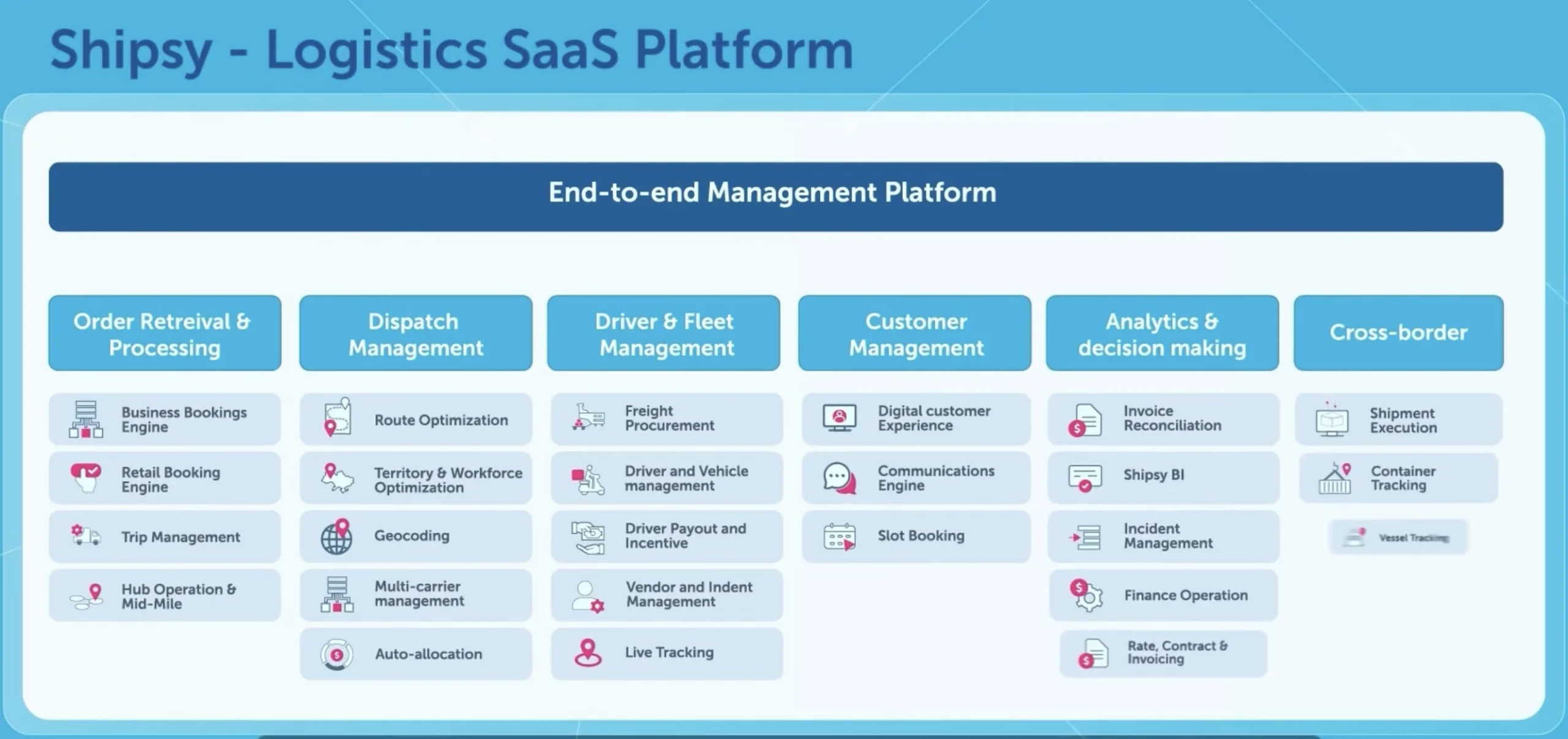
Shipsy is an enterprise-grade AI logistics orchestration platform combining a full TMS, WMS, and a set of autonomous AI agents. It’s used by Aramex, Qatar Post, Asendia, and Nippon Express, and was included in the 2026 Gartner Magic Quadrant for TMS.
This is not a tool for SMB couriers. If you’re running a national parcel network, a large 3PL, or an enterprise retail logistics operation, Shipsy is in a different category from the other tools on this list.
Key features
- AgentFleet: native AI agent workforce covering routing exceptions, customer WISMO, route optimization, invoice reconciliation, and dispute resolution
- 240+ carrier integrations for multi-carrier management across national and international networks
- Full TMS + WMS covering first-mile, hub operations, mid-mile linehaul, and last-mile delivery
- AI-powered NDR rescue: automated failed-delivery handling at scale
- Cross-border logistics with customs documentation and international compliance
Pros
- Native AI agent workforce: automates routing, customer queries, and reconciliation without manual intervention
- 2026 Gartner Magic Quadrant recognition: independent enterprise validation
- 240+ carrier integrations: broad scope for multi-carrier networks
- Customers report measurable ROI: cited 23% average cost reduction across logistics operations
Cons
- Not accessible to SMBs: custom pricing, enterprise sales process, no transparent cost model
- 8–12 week deployment timeline: a significant commitment before going live
- Support on complex issues has been cited as slow: workarounds provided rather than permanent resolutions in some cases
- No self-serve trial: demo-only access via sales engagement
Pricing
- Custom enterprise pricing: no public price list
- Designed for operations processing 10,000+ daily shipments
- Total cost includes implementation services, integration development, and training
Bottom line
Shipsy serves a fundamentally different buyer than the other four tools. The entry question is not which features it has, but whether your operation is large and complex enough to justify an enterprise TMS deployment. For post and parcel carriers and large 3PLs, it’s a serious contender. For everyone else, it’s the wrong category.
3. Tookan: Best for on-demand delivery businesses that want an extensible, add-on-based platform
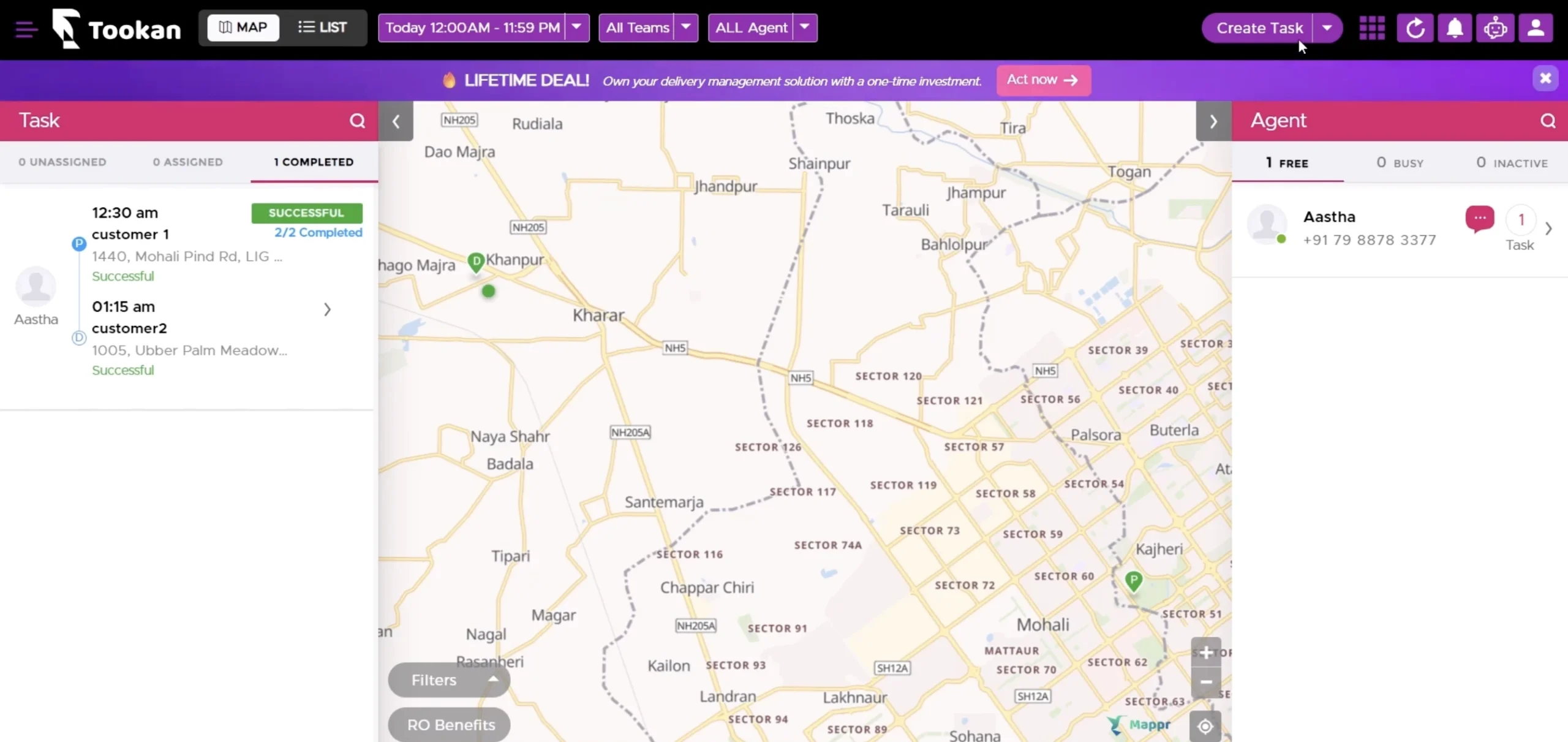
Tookan, built by JungleWorks, is a highly extensible delivery management platform with genuine on-demand dispatch capabilities and an ecosystem of 150+ add-ons. It’s known for its nearest-available-agent auto-dispatch, its broad integrations library, and the flexibility that comes from building your feature stack through the extensions marketplace.
That flexibility comes with an important caveat: the headline price is not the real price. Route optimization, ETA notifications, and analytics all cost extra. By the time you assemble a functional courier operation, you’re often paying multiples of the base subscription.
Key features
- Automated nearest-agent dispatch: auto-assigns tasks to the closest available driver in real time
- Extensions marketplace with 150+ add-ons: one of the largest in the SMB courier segment
- Barcode scanning in driver app: included in the core platform, no add-on required
- Agent Wallet for COD and cash tracking: tracks all cash transactions per driver with supervisor oversight
- 90+ native integrations including Shopify, WooCommerce, Stripe, and Zapier
- Webhooks and REST API for event-driven integrations with external systems
Pros
- Genuine on-demand auto-dispatch: nearest-available-agent logic is real, not just batch optimization
- Barcode scanning included in the core platform without an add-on surcharge
- Largest extensions marketplace in this review set: virtually any workflow can be covered by combining add-ons
- COD and Agent Wallet are well-implemented first-class features
Cons
- Route optimization is a paid add-on at $0.12/task: not included in any base plan
- ETA notifications are a paid add-on at $49/month: a basic customer expectation costs extra
- 14% of Capterra reviews are 1-star: recurring themes include features promised in sales that weren’t available, and unresponsive post-payment support
- Pickup and delivery split into two separate task entries: adds administrative overhead and driver confusion
- No hub operations or courier billing engine: not a full courier TMS
Pricing
- Entry plan: approximately $39/month for 200 tasks; additional tasks at $0.22 each
- Five pricing tiers up to Enterprise (custom pricing)
- 14-day free trial, no credit card required
- The real monthly cost at 1,000 tasks with essential add-ons is approximately $250–$340/month
Bottom line
Tookan works well for on-demand food delivery, grocery, and marketplace businesses with technical teams that can configure an add-on-heavy platform. The add-on pricing model means the cost comparison against all-inclusive alternatives must be done carefully, and the 14% one-star review rate on Capterra is worth investigating before committing.
4. Routific: Best for small-to-mid fleets optimizing planned multi-stop delivery routes
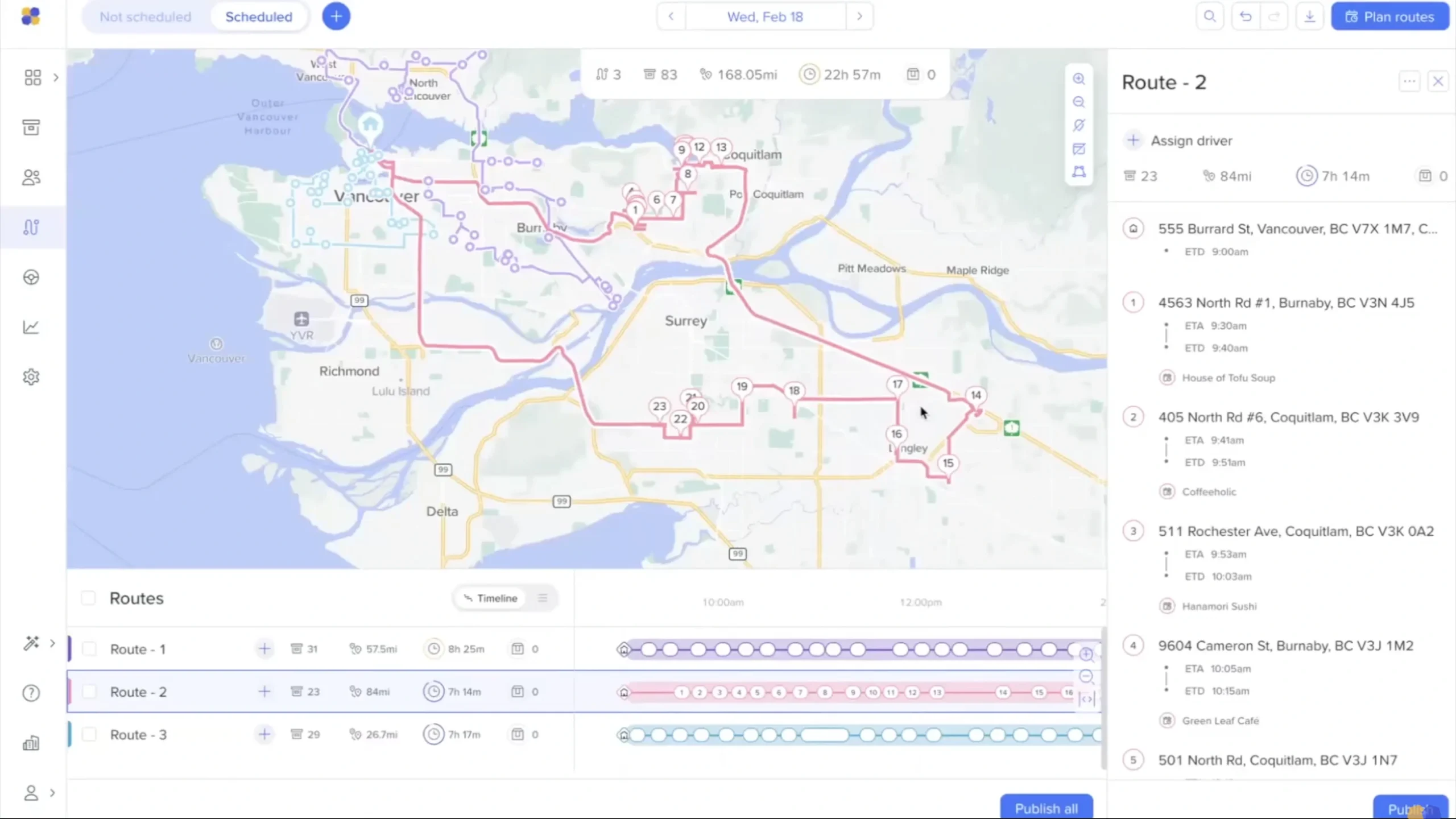
Routific is a clean, purpose-built route optimization tool for delivery businesses that plan routes in advance. It doesn’t try to be a courier TMS or an on-demand dispatch engine. What it does, optimize multi-driver, multi-stop routes for planned batch deliveries, it does very well.
The numbers back this up: 4.9/5 on Capterra across 140+ reviews, with support consistently rated among the most responsive in this category.
Key features
- AI-powered route algorithm that produces non-overlapping, logical routes with traffic awareness
- Drag-and-drop route editing: dispatchers can manually adjust stops and reassign between drivers
- Browser-based driver app: works on iOS and Android without a native app download
- Proof of delivery: photo capture and customer signature
- Native Shopify and WooCommerce integrations for e-commerce order flow
- REST API and Zapier integration for connecting external order management systems
Pros
- Route algorithm quality: reviewers consistently credit it with cutting route planning from a full day’s work to under 5 minutes
- Extremely low learning curve: most teams are operational within an hour of signing up
- Transparent, order-based pricing with a permanent free tier (100 orders/month)
- Support rated 4.9/5: in-house team, consistently praised as responsive and human
Cons
- Not an on-demand or live dispatch platform: no continuous incoming order queue
- No COD, driver wallet, or financial reconciliation: a hard limitation for cash-on-delivery operations
- No multi-merchant billing or hub operations: not suitable for courier networks with sorting or transfer workflows
- SMS notifications are a paid add-on: priced per vehicle per month
Pricing
- Free tier: up to 100 orders/month with full feature access
- $150/month: up to 1,000 orders/month
- 7-day free trial, all features, no credit card required
- Single plan with automatic volume discounts; all features included at every level
Bottom line
Routific excels at one specific use case: collecting orders in advance and dispatching them in planned batches. If that describes your operation, it will likely save you meaningful time every day. If your operation involves on-demand dispatch, hub workflows, or COD, it’s the wrong category of software.
5. GSMtasks: Best for small delivery teams needing affordable, straightforward task and route management
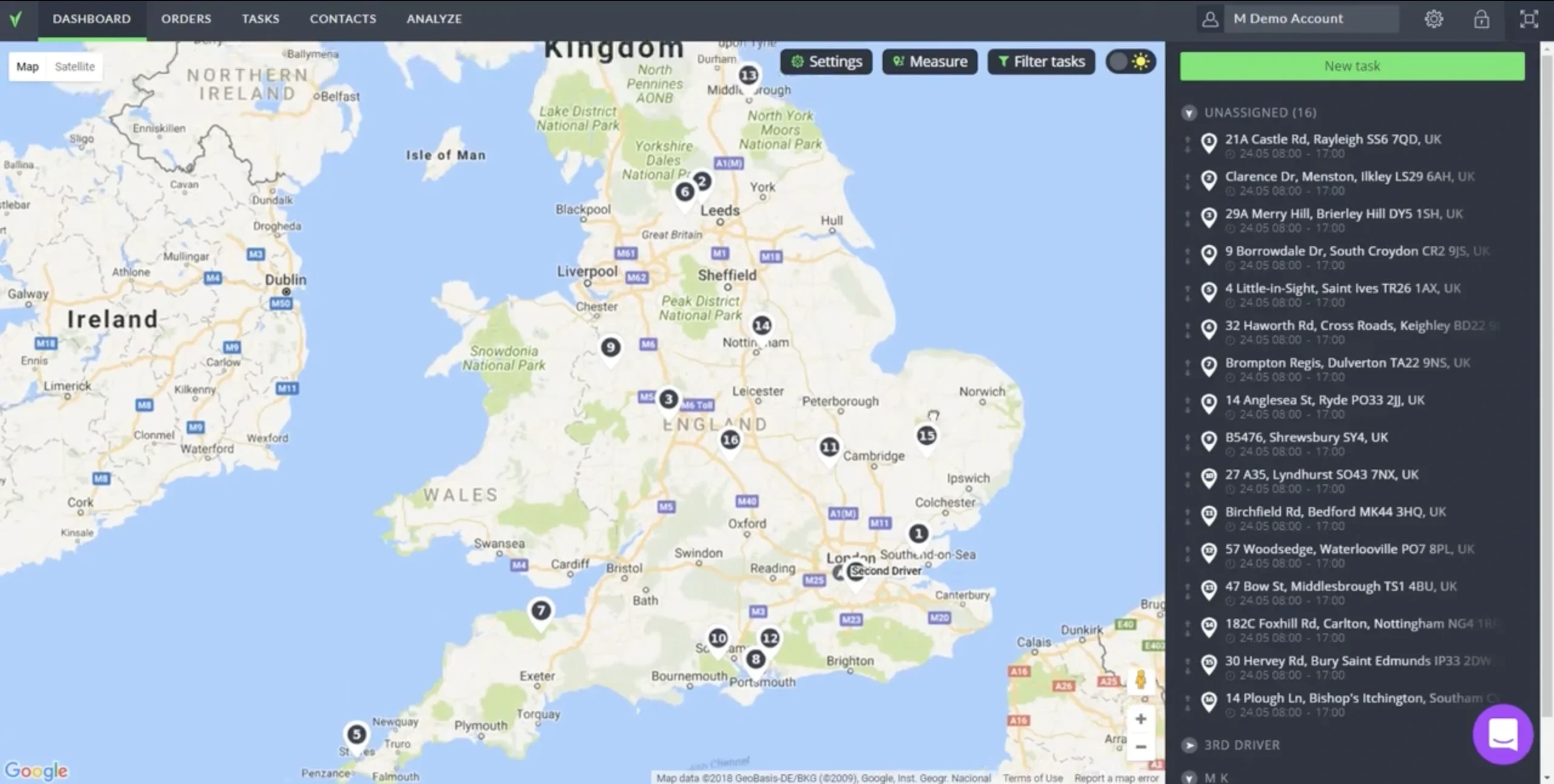
GSMtasks is an affordable fleet and delivery management platform for small teams that want to move off WhatsApp and spreadsheets. It combines route optimization, real-time driver tracking, proof of delivery, and customer notifications in a flat per-user pricing model with unlimited tasks.
The value proposition is clear: fixed monthly cost, no per-shipment overage, and a clean enough interface that teams are operational quickly. The trade-off is depth, GSMtasks is a field service tool with solid delivery features, not a purpose-built courier platform.
Key features
- Route optimization with automated multi-stop routing: available on Professional plan (€19/user/month) and above
- Real-time GPS driver tracking via native iOS and Android app
- Proof of delivery: photo capture and digital signature
- Customer SMS and email notifications: white-label email on Professional+
- Email parsing for pulling orders from food delivery platforms automatically
- REST API for custom integrations with external systems
Pros
- Lowest entry price per user in this review set: €14/user/month with unlimited tasks
- No per-shipment overage fees: flat per-user billing regardless of task volume
- Customer support consistently praised across reviews as responsive and handled by real people, not bots
- Quick setup: teams typically get running within hours
Cons
- Route optimization requires the Professional plan (€19/user/month): not included in the entry Essential plan
- No COD or driver wallet: a hard gap for cash-on-delivery operations
- No multi-merchant billing, hub operations, or scan-based chain-of-custody
- App stability issues on certain Android devices: GPS location failures cited in reviews on Capterra
Pricing
- Essential plan: €14/user/month, basic task management and tracking; no route optimization
- Professional plan: €19/user/month, adds route optimization, white-label email, and offline mobile app
- Enterprise plan: custom pricing
- 14-day free trial, no credit card required
Bottom line
GSMtasks is a solid step up from manual coordination for small delivery teams. The unlimited tasks model at a flat per-user rate is genuinely attractive for high-volume small operations. For courier businesses with COD, multi-merchant clients, or hub workflows, it runs out of depth quickly.
How I evaluated these software platforms for courier companies
I assessed each platform across real courier operations scenarios rather than feature checklists alone. My goal was to understand how well each tool handles the workflows a courier business actually runs day-to-day.
I simulated an on-demand dispatch operation, a same-day batch routing scenario, and a multi-merchant COD collection run, then measured how each platform handled setup, execution, and exception management.
Here’s what I looked for:
- Delivery model fit: Does the tool actually support on-demand dispatch, or is it just a batch routing engine wearing a delivery label? Most platforms in this space market to couriers but are built for simpler fleet management scenarios.
- Operational depth: Features like hub scanning, COD wallets, and SLA alerting separate courier platforms from general delivery management tools. I noted exactly where each platform stopped.
- Total cost of ownership: Some platforms advertise a low entry price and charge for everything critical as add-ons. I calculated the real monthly cost for a typical courier operation at 1,000 tasks/month.
- Support and reliability: I checked support response patterns across Capterra, G2, and Gartner Peer Insights. A platform that goes unresponsive after payment is a different kind of risk than one with a steep learning curve.
Which software should your courier company choose?
Your best option depends heavily on what kind of delivery operation you’re running. Here are the scenarios that map most clearly to each platform.
Choose Onro if you:
- Run a courier business handling on-demand, same-day, or next-day delivery, or all three simultaneously
- Need hub operations with scan-based chain-of-custody at a sorting facility
- Serve multiple merchant clients and need per-client pricing, invoicing, and portals
Choose Shipsy if you:
- Run a post and parcel carrier, large 3PL, or national retail logistics operation processing thousands of shipments daily
- Need multi-carrier management across a complex network of domestic and international partners
- Have the organizational readiness for an 8–12 week enterprise deployment
Choose Tookan if you:
- Operate an on-demand delivery business in food, grocery, or marketplace delivery
- Want a highly customizable platform and are comfortable paying for individual add-ons
- Have a technical team that can configure APIs, extensions, and integrations
Choose Routific if you:
- Run a planned batch delivery operation: orders collected in advance, dispatched in daily runs
- Are currently planning routes with Google Maps or spreadsheets and want to automate that process
- Don’t need on-demand dispatch, COD, or hub operations
Choose GSMtasks if you:
- Lead a small delivery or field service team needing basic route optimization and tracking
- Want unlimited tasks at a flat per-user rate without worrying about per-shipment overages
- Are moving off WhatsApp and spreadsheet coordination for the first time
My final verdict
Courier software in 2026 covers a wide spectrum, from simple route optimization tools to full enterprise TMS platforms with autonomous AI agents. The five platforms on this list represent genuinely different categories, so the right pick depends on where your operation sits.
For most courier companies, Onro matches the category well. It covers dispatch, hub operations, COD settlement, multi-merchant billing, and white-label branding in a single product that isn’t priced for enterprise budgets. The small review count is a legitimate gap to weigh before committing.
For enterprise carriers and 3PLs, Shipsy stands in its own tier. The Gartner recognition, the AI agent fleet, and the 240+ carrier integrations are the real deal. If you’re Aramex-scale or heading there, the evaluation conversation is with Shipsy.
For on-demand food and grocery delivery, Tookan’s auto-dispatch architecture and extensions ecosystem are a good fit, just go in with eyes open about the real total cost once you’ve added the essential add-ons.
For planned batch routing, Routific is the cleanest, simplest, highest-rated option on this list. It does one thing very well and the pricing is transparent.
For small teams on a tight budget, GSMtasks provides solid basics at a price point that’s hard to beat. Just make sure you’re on the Professional plan if route optimization matters.
The right software for your courier company is the one that maps to your delivery model, not the one with the longest feature list.
FAQ: Best Courier Service Software 2026
What is the best software for small courier companies in 2026?
Routific and GSMtasks are the best options for small courier businesses depending on your needs. Routific is the better choice if your priority is fast, accurate route planning for planned deliveries. GSMtasks is better if you need both delivery and field service management at the lowest per-user cost. For small courier companies that already serve multiple merchant clients, Onro’s Business plan at $239/month is worth evaluating, it includes operational depth the other two can’t match.
Which software for courier companies handles cash on delivery (COD)?
Onro and Tookan both handle COD natively. Onro includes a full driver wallet with COD collection, tracking, and settlement workflows. Tookan includes an Agent Wallet that tracks cash transactions per driver. Shipsy also handles COD at enterprise scale. Routific and GSMtasks do not support COD.
Do any of these courier platforms support hub operations?
Onro is the only platform on this list with dedicated hub operations support, including a scanner app for inbound and outbound scanning, sorting by zone, and hub-to-hub transfer. Shipsy also supports hub operations at enterprise scale. Tookan, Routific, and GSMtasks do not have hub scanning or sorting capabilities.
Can I white-label any of these courier platforms?
Onro offers the most complete white-label option at the SMB-to-mid-market level, covering customer app, driver app, dispatcher panel, and tracking pages under your own domain. This requires the Enterprise plan. Tookan has white-label options that require verification with the vendor. Routific and GSMtasks do not offer meaningful white-label branding.
Which of these software platforms is best for route optimization?
Routific is the highest-rated pure route optimization tool in this review set, with a 4.9/5 on Capterra across 140+ reviews. For operations that also need dispatch, COD, or hub workflows alongside optimization, Onro includes route optimization as part of its broader platform without add-on fees. Tookan also offers route optimization but charges $0.12 per task as a paid add-on.